

I would tell you more about this specimen but Animal Collective thinks it might be grammy material so I have to exercise discretion.
minor musings on the macrocosm
I would tell you more about this specimen but Animal Collective thinks it might be grammy material so I have to exercise discretion.
Yesterday’s XKCD makes a good point except of course that belief in the supernatural and cryptozoologic can be stoked, but never be crushed by iPhones or instagram. The ability to construct and disseminate hoax, fraud and rumor follow similar but maybe steeper curves. Not that this is all a grassroots phenomenon.
The following exchange took place in my oceanography class this summer:
student: I know this is going to sound stupid, but I have to ask you this.
me: Go for it.
student: Ok so, I’m a nerd, and I watch the Discovery Channel.
me: I watch Discovery, what are you saying? [note: this is basically a lie, but I thought it would make for humorous banter]
other student: Ohmygawd I LOVE River Monsters.
other other student: I’ve watched that like ten times. It’s ALWAYS a catfish.
original student: No, no, I have to ask this. Is there like a small chance, I mean like ANY chance that mermaids are real?
me: [literally SMH]
Coincidentally (OR IS IT!?) today’s Tet Zoo deconstructs some best of Nessie photos (aka NOW that’s what I call Nessie Vol. IX). Toward the end of that post, Darren reports that props from cryptozoological television specials are now apparently being repurposed to foist new hoaxes on the loch … which no doubt will attract new television crews … who will build more props …
None of which–the sorry state of “scientific” television programming, the slimy hucksters that pose as outsider scientists, the general dumbness of people–particularly gets me down.
Except! I was getting terminal facemelt from today’s B^3 post when it hit me: there are many, many, more people who are obsessed with animals THAT DON’T EXIST, than people who even just maybe know about actual live living real life actually really real magical monsters like Fiery-throated Hummingbirds, or even Resplendent Quetzals (a bird which is, quite literally, money).
Which, I’m too old to be crotchety anymore, but just seems, well, kinda sad.
But then you see an amazing video like the one up top there where a fantastical animal that shouldn’t even be there, calmly waltzes into view and you remember that there is magic in the world that could never be touched by profit-crazed production companies or pseudoscientific fame-whores.
Thanks internetses!
you already saw these, and anyway the data are bit stale, and maybe the methodology is problematic but anyway I’ll put them here and forestall for the time being

the commentary about the fluidity (and pointlessness) of folk taxonomies and the just so of how the éscrevisse became a fish and how the fish became a dad
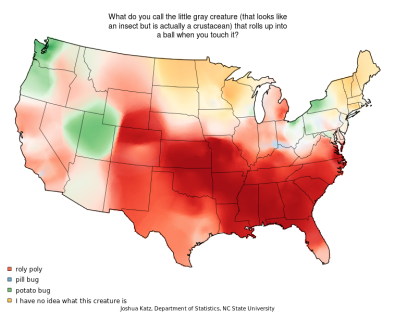 and the depauperate isopod fauna of the upper plains states (thanks to the Laurentide ice sheet and a lingering glacial hang-over? [I think I wish Vaux and Golder had asked about earthworms])

which reminds me I’ve never seen good explanation for the absence of lampyrids west of the Rockies [?] and why should lightning bug have such strong currency in the core of their North American range and firefly be such an outsiderism

and wow have we finally found the exception to the rule that your “bugs” aren’t bugs? News to me and “water strider,” OK fine, but my favored childhood variant “water skeeter” doesn’t even poll ?!?!?1?!
As much as we use different words to talk about the same thing, it seems that we are just as likely to be using the same words to talk about different things see: “backstrider” “doodlebug” “potato bug” and on, and on, and

I mean. So you think the small grey terrestrial crustaceans that roll up in a ball are …
um centipedes. Dude did you even try counting their legs.
and don’t even get me started on nearly literal bugbear that is good old “daddy longlegs” except to note the sparse college town pockets that use “harvestmen” to call their opiliones. NERDS!
I think it was George Bernard Shaw that said, we are one country separated by a series of common misunderstandings about small animals with exoskeletons and jointed appendages and an imprecise and a wildly inconsistent vernacular applied to diagnose the same.
Or something like that.

NB: I’m putting this here ’cause, the Tumblr theme I insist on using is dreadful for longform and I don’t know if Yahoo is going to eat all of my brains and turn them into daily horrorscopes or whatever and Google is about to kill reader so bye and thanks if we lose touch and I know I shouldn’t be publishing quasi-original [though admittedly trivial] Google books assisted history of science research on this neglected podunk weblog again but so sue me and maybe if I get the chance I will tell you about the UN sometime but so anyway here we are.
Mary Anning’s “fourth notebook” is a “commonplace book” that dates from the last years of the famous fossil hunter’s life. The book, which somehow wound up in the personal library of Richard Owen and is now in the collection of the Dorset County Museum, contains several distinctive essays and poems. The authorship of these have sometimes been attributed to Anning herself (for example see this fine recent biographical sketch by Davis [2009]) but it appears more likely that she actually transcribed them from other publications. I guess this is the kind of thing people did before Tumblr.
One poem (the first few lines of which are shown in Mary’s hand above) is particularly entertaining, at least assuming that you are hip to inside jokes about early 19th Century geologists and geological debates. It is a satirical ode to Roderick Murchison, the Scottish geologist who was knighted in 1846.
It appears to have been composed by a Cambridge physician writing under the pseudonym “The Travelling Bachelor” and was originally published in Bentley’s Miscellany in 1846. It was transcribed by Anning in the same year, or shortly thereafter. Mary was well acquainted with the Victorian scientists that are lampooned in the poem, and we can imagine she was amused by the send-up, although whether she was sympathetic to the sentiments is hard to say. Owen himself gets a gentle ribbing about his anatomical obsessions, one wonders if he was amused or irritated by this poem that was so carefully copied down by Anning.
Encomium Murchisonaum
Who first surveyed the Russian states?
And made the great Azoic dates?
And worked the Scandinavian states?
Sir Roderick
Who calculated nature’s shocks?
And proved the low Silurian rock
Detritus of more ancient flocks?
Sir Roderick
Who knows of what all rocks consist?
And sees his way where all is mist
About the metamorphic schist?
Sir Roderick
Who draws distinctions clear and nice
Between the old and new gneiss?
And talks no nonsense about ice.
Sir Roderick
Let others then, their stand maintain,
Work all for glory, nought for gain,
And each finds faults, but none complain.
Sir Roderick
Let Sedgwick say how things began,
Defend the old creation plan,
And smash the new one, if he can.
Sir Roderick
Let Buckland set the land to rights,
Find meat and peas, and starch in blights,
And future food in coprolites.
Sir Roderick
Let Agassiz appreciate tails,
And like the virgin old the scales,
And Owen draw the teeth of whales.
Sir Roderick
Take Thou thy orders hard to spell,
And titles more then man can spell.
I wish all such were earned so well.
Sir Roderick


back in bad old days I would have taken the discovery of extensive hind-limb feathering in Mesozoic birds (Zheng el al. 2013 just published in Science) as an invitation to leap off into half-formed speculations about serial homology and scansoriality, or launch a never to be completed series of posts about phugoids, or try to coin some dumb, clonky neologism like “glight.”
Or at least tilt, askance (if that’s not overdoing it), at some windmill of a science writer, and flail and froth against some perceived distortion or mislocution, all pshaw and tsk and really? I mean, really? I mean. Come on. My disheveled and worn tibiotarsal feathers would have literally ruffled in a sadly unconvincing bluff.
These days I just fly over all that crap. Like glorious tropic bird, I soar far above and beyond gliding on trade winds over the horizon until my luminous volant form becomes one with comet Pan-STARRS.
But. Let me swoop down among the motley enantiornithine fray for just one sec to say,
The 150-million-year-old Archaeopteryx from Germany, sometimes called the first bird, probably had feathers on its forelimbs. But recent fossil finds question whether it was a birdlike dinosaur rather than a dinosaurlike member of the true bird lineage. So the Chinese team wrote that, only until now, no examples of the unusual four-wing structure “have so far been reported in basal birds.”
Archaeopteryx “probably had feathers on its forelimbs”?
Perhaps, “hindlimbs” is what is meant. If so this passage resolves into semi-comprehensibility. But the whole “birdlike dinosaur” vs “dinosaurlike member of the true bird lineage” circumlocution still bugs me. It underscores why the apparently irrepressible urge to draw a line in the sand with “birds” on one side and “dinosaurs” on the other is entirely misbegotten. Especially with deinonychosaurs and scansoriopterygids and Xiaotingia and even Archie herself dancing around the avialan tree like some drunken dryads at an absinthe party.
Wait. What was I saying? Never mind. Got it out of my system.
Aight, dudes, imma go back to high-fiving Beebe in my celestial pleasure dome. Smell you later.
[rescued, sort of, from the dust bin of the draft folder]
\
It’s that time of year that we turn our attention to those beefiest of squirrels, the marmots. Marmota is a genus of large-bodied ground squirrel comprising fourteen or so species scattered about the mid to high-latitude regions of the Northern Hemisphere, a distribution properly termed “Holarctic.” Both fossil evidence and genetic relationships among the species suggest a New World origin for marmots followed by dispersal across the Bering land bridge in the Late Pliocene into Eurasia (Steppan et al. 1999), though one North American species, M. broweri, the Alaskan marmot, appears to be a Pleistocene re-immigrant from Asia.
Growing up in California, I tend to think of marmots as animals of the high country. Yet the most familiar North American species, or at least the most of nicknamed is M. monax aka “woodchuck”, “groundhog”, “whistlepig”,”siffleur”, “land beaver” &c. (though I’m dubious whether that last really has any kind of currency.) “Woodchuck” is apparently something of an eggcorn, corrupted from an array names “wuchak/wejack/ojeeg” given by Algonquin-speaking tribes to quite another animal, the large North American weasel, Martes pennanti, now generally called a “fisher” (or misleadingly a “fisher cat”) but once known in some parts as a “woodshock.” This is another example of the twisted game of what might be called “Ojibwe whispers“, that confused chain of mistakes, miscommunications and misappellations that named the “New World” flora and fauna (see: wapiti/moose/elk, chipmunk, kinkajou, potato, alligator, turkey).
Though nowadays obsolete, I’m rather partial to the name used by most early naturalists, “monax,” a riff on an Algonquin word monham meaning “to dig” and a word that was apparently actually use by native peoples for the proper species, unlike wuchak. Pity that “monax” and it’s variants, monack, moonack etc. have all fallen into disuse and we’re left with two rather dull and more or less inappropriate alternatives, tongue-twisters aside.
Mark Catesby provides one of the earliest quasi-scientific accounts of the monax in an appendix to his landmark work Natural History of Carolina, Florida and the Bahama Islands, although the animal was no doubt was already quite familiar to European settlers:
MARMOTA America
The Monax
This animal is about the Bigness of a wild Rabbet: and of a brown Colour, the Head also resembles most that of a Rabbet, except that the ears are short, like the those of a Squirrel; the Feet are like those of a Rat, the Tail like that of a Squirrel, but much less hairy. It feeds on Bread, Fruit, and other Vegetable Diet. At certain Times they retire to their subterraneous Lodgings, and sleep continually a Month or longer together: They are Inhabitants of Maryland, Pensilvania &c. Their Flesh is esteemed good Meat. (Natural History … V. 2 xxvii)

What is this exactly? Not a monax.
Elsewhere in that same work Catesby illustrated an entirely different rodent (above), which he calls “Ciniculus Bahamaensis – The Bahama Coney” along with another brief description:
This creature is a little less than the common Wild Rabbit and of a brown Colour without a Mixture of gray Hairs. Its Ears, Feet and Tail resemble those of a Rat, in other Parts it is somewhat like a Rabbit. They feed wholly on wild Fruit and other Vegetables; When furpriz’d by Hunters they retreat to Holes in Rocks. Theif Flesh is efteemed very good, it has more the Taste of a Pig than that of a Rabbit. I take it to be nearly of the Kind of the Mus Alpinus or Marmot. (Ibid, 79)
Catesby’s “Bahama Coney” is almost certainly some species of hutia but the passing reference to a marmot confused a generation of European naturalists who took the two descriptions to mean that the monax or a similar species was distributed across the North American continent and the Caribbean islands.

By being fed with soft Meats, and Disuse to gnaw, its Teeth grew so long and crooked, that it could not take in its Food, so to preferve its Life, they were obliged to break them out. This Drawing was taken, as it lay by the Fire reposing itself
Around the same time, George Edwards illustrated an exotic rodent kept by his homeboy Sir Hans Sloane supposed to have been imported from Maryland, along with a brief account. While the behavioral notes recorded by Edwards are mostly consistent with M. monax, the short pelage, long, slender tail and elongate curved claws are at odds with the familiar characteristics of the true groundhog, and raise the question of which American rodent lounging around his fireplace Hans Sloane had knocked the teeth out of, exactly. In some respects, Edwards’ illustration seems even a better match for the West Indian hutias than Catesby’s “Bahama Coney”. But these guys, and their rodent associates are long dead and who really cares anyway?

From a letter from James Madison to Thomas Jefferson (May 12, 1786):
You have, I believe, justly considered our Monax as the Marmotte of Europe. I have lately had an opportunity of examining a female one with some attention. Its weight, after it had lost a good deal of blood, was 51 lbs. Its dimensions, shape, teeth, and structure within, as far as I could judge, corresponded in substance with the description given by D’Aubenton. In sundry minute circumstances a precise correspondence was also observable. The principal variations were: 1″, in the face, which was shorter in the Monax than in the proportions of the Marmottc, and was less arched about the root of the nose. 2ui, in the feet, each of the forefeet having a fifth nail, about 3 of an inch long, growing out of the inward side of the heel, without any visible toe. From this particular it would seem to be the Marmotte of Poland, called the Bobac, rather than the Alpine Marmotte. 3rd, in the teats, which were 8 only. The marmotte in Buffon had 10. 4th, in several circumstances of its robe, particularly of that of the belly, which consisted of a short, coarse, thin hair, whereas this part of Buffon’s marmotte was covered with a thicker fur than the back, &c.
A very material circumstance in the comparison remains to be ascertained. The European Marmotte is in the class of those which arc dormant during the winter. No person here of whom I have enquired can decide whether this be a quality of the Monax. I infer that it is of the dormant class, not only from its similitude to the Marmotte in other respects, but from the sensible coldness of the Monax I examined, compared with the human body, although the vital heat of quadrupeds is said, in general, to be greater than that of man. This inferiority of heat being a characteristic of animals which become torpid from cold, I should consider it as deciding the quality of the Monax in this respect, were it not that the subject of my examination, though it remained alive several days, was so crippled and apparently dying the whole time, that its actual heat could not fairly be taken for the degree of its natural heat. If it had recovered, I intended to have made a trial with the Thermometer. I now propose to have, if I can, one of their habitations discovered during the summer, and to open it on some cold day next winter. This will fix the matter. There is another circumstance which belongs to a full comparison of the two animals. The Marmotte of Europe is said to be an inhabitant of the upper region of mountains only. Whether our Monax be confined to mountainous situations or not, I have not yet learnt. If it be not found as a permanent inhabitant of the level conntry, it certainly descends occasionally into the plains which are in the neighborhood of mountains.
I don’t know if contemporary U.S. “statesmen” (lol) exchange letters about the natural history of small native mammals, but if not, it no doubt goes a long way toward explaining the contemporary atmosphere of partisan gridlock. I mean if a Federalist and an Anti-Federalist could come together to discuss the finer details of rodent metabolism, surely the deficit crisis is tractable?
Candlemas is a reasonable enough time to check in on the weather, as if falls roughly midway between the Winter Solstice and the Vernal Equinox. Animal activities have long been used to prognosticate future weather conditions, an impulse that clearly has its roots in sound observational awareness of the daily and annual rhythms that punctuate the natural world. Over-endowed with computational power and under-endowed with editing abilities, humans have woven these practices into an self-fulfilling hodge podge of absurd aphorisms and empty ritual. It was probably German immigrants that brought to the Americas folklore about the implications of seeing a mammal ambling about on Candlemas day, probably a badger or bear in the original telling. Somehow this folkloric forecasting exercise got transplanted to our beefy terrestrial squirrel, no doubt due to the obviously regimented seasonal activity cycle that sparked the curiosity of James Madison.
Go figure.
For what it’s worth – here in Nashville it snowed in the morning, rained mid-day and was sunny and clear by eventide. Oddly, I saw no rodents of any kind. But I did by a Twin Shadow CD. I think that means four more years of partisan gridlock.

microecos: Hey dude.
Dr. Neil Patrick Kelley: ¿sup?
m.e.: been awhile!
me: no doubt. did that video though.
m.e.: whatcha been up to?
me: finished my dissertation! also, freelance herp ids on the blogs.
m.e.: big ups. and you had a kid right?
me: Yes! She’s a year old already.
m.e.: explains the slow down around here, I guess.
me: Oh. yeah. sorry. Have you seen my Tumblr?
m.e.: um. yeah. how much of that is “you”.
me: depends. sometimes I append lengthy comments to things there, so I “engage” with the “material” at least.
m.e.: I don’t think that’s how Tumblr works. Anyway with the theme you are using you can’t even see that stuff.
me: you’re probably right.
m.e.: so.
me: so….
m.e.:
me: I was thinking though, now that I’ve got that out of the way I can start reblogging in earnest. I mean, resume blogging. Original stuff.
m.e.: well you’ve got the microecos.com domain so you need to do something with that.
me: Ugh. that sounds like so much work.
m.e.: love “Dust. Wind. Dude.” though. Classic shit.
me: Yeah.
m.e.: can I level with you?
me: of course!
m.e.: I don’t know. I’m not sure that I can get back to that, *level*. What do people even blog about NOW?
me: Shut up, you read 172 blogs religiously.
m.e.: Srsly.
me: You know that blog, Ichthyosaurs: a day in the life?
m.e.: Love it.
me: I did this:
m.e.: Yikes.
me: …
m.e.: Ease up on the distortion. Everyone knows you can’t sing. But you are stomping on your jokes there.
me: Jokes?
m.e.: “Nobody was really sure/If she was a stem-archosauromorph?”
me: zing!
m.e.: I like how you break the rhyme there. Very Sir A. L. Webster. But breviceps is still in Ichthyosaurus right?
me: I think I meant <i>jancieps</i>. Ugh. how did I pass?
m.e.: Generosity. I don’t think we’re in an html interface.
me: This seems indulgent.
m.e.: which?
mi: right
yo: You’ve still got the 15 valid thalattosaur species to blog about right? Everyone’s waiting.
i: depends how you count, <i>Anshunsaurus</i> is a little volatile … ?<i>Blezingeria</i>
m.e.: Dude. Markup.
me: Dude. Marker’s Mark. RIP:
m.e.: Nobody will watch that. WordPress enforces a strict 1 video embed only policy. To preserve people’s sanity.
me: Good for them. ALL of them.
m.e.: I was going to title the one about the North American species: “North American Scum”
mi: I get it, they’re all so fragmentary. Agkistrognathus is pretty sick though, not nearly enough play in the liberal media.
m.e.: Whooping Cranes nearby. Maybe 10 klicks.
me: Private property. Can’t see them.
m.e.: Good for them. ALL of them.
me: Is the Marker video working now?


 microecos